Whale and Dolphin Watching Cape Town
Whale Watching Cape Town
“They watched the whales float in the murk, blowing spray into the air. After a minute, the mother showed them her eye again, unblinking and huge. Then she and her calf dipped back under the surface. It was an impossible thing: so many tons of flesh, disappearing in an instant.”
― Robbie Arnott, Limberlost
A Whale Watching Guide to Cape Town
Whale Watching Cape Town, False Bay and Hermanus
Cape Town is a place where mountain, land and sea meet with unusual intensity, creating one of the world’s great biodiversity hotspots. This diversity is most obvious on land in the extraordinary concentration of endemic plants that make up The Cape Floral Kingdom, however the marine environment tells an equally remarkable, but less familiar story.
The Cape Peninsula projects out across the continental shelf, separating the cold, nutrient-rich waters of the Atlantic coast from the more sheltered marine environments of False Bay, Betty’s Bay and Hermanus to the east. These waters are travelled by some of the largest animals on Earth.
Whales are an integral part of this living system. Their migrations and movements tracing invisible highways that extend for thousands of kilometers, connecting the waters of the Cape to tropical breeding grounds in the north and to the rich feeding grounds of the Southern Ocean to the south.
Whale Watching Seasons in Cape Town
When is the best time to watch whales in Cape Town?
Cape Town is a year-round whale and dolphin watching destination, with distinct summer and winter seasons, although there is considerable variation and overlap in the species, numbers and best areas.
Winter and spring, from June through October, form the traditional whale season. Southern right whales return to the southern Cape coast to give birth and nurse their calves, while humpback whales make both fine-scale and long-distance movements around the Cape Peninsula.
Summer brings a very different pattern. Nutrient-rich upwelling along the Atlantic coast supports highly productive feeding grounds, and humpback whales may gather around Cape Town, Yzerfontein and further north up the West Coast. Southern right whales may also be found feeding in these areas during summer.
The transition between these seasons is not always clearly defined. November and early summer may combine southbound migrating whales with increasing feeding activity, while individual whales and feeding events can occur outside the expected seasonal pattern.
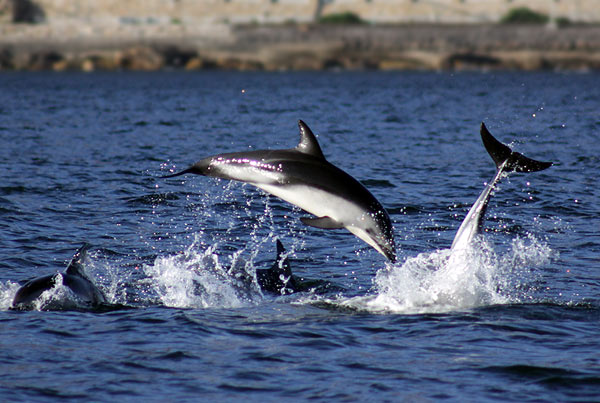
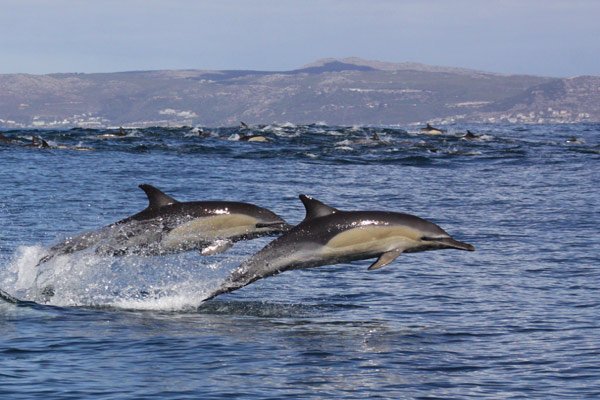
If Cape Town has a low season for whales, it is generally around March, April and May. Even then, the marine environment is far from quiet. Large groups of common dolphins can be found in False Bay during this period, sometimes forming superpods numbering several thousands of animals. To see these supergroups of dolphins sweeping through False Bay is one of the most exhilarating natural spectacles we can experience.
Where to Watch Whales in Cape Town
False Bay, Cape Point and the Atlantic Coast
Cape Town is a city defined by mountains and surrounded by ocean on three sides, so almost any tour of the city will take you through a possible whale-watching area. For simplicity it’s easiest to think of the city divided into two main areas: False Bay and Atlantic coast.
On the Atlantic seaboard, Table Bay, Camps Bay and Robben Island can all be accessed by boat from the V&A Waterfront, while Hout Bay is the logical departure point for Duiker Island, Maori Bay and the coastline south towards Kommetjie and Slangkop Lighthouse.
The Atlantic seaboard is exposed to the full force of winter cold fronts, but it is the best option during the summer months when prevailing SE winds can plague the False Bay side.
False Bay, on the eastern side of the Cape Peninsula, lies in the lee of the prevailing westerly winds in winter. The bay is a prime location for whale watching, scuba diving and snorkeling charters.
Further to the east, Hermanus is easily included in a full-day itinerary from Cape Town and is well worth the journey if finding southern right whales are your priority.
Whale Watching in Simonstown
False Bay, Simon's Town to Cape Point
Simonstown on the False Bay side of the Cape South Peninsula is a town rich in naval and whaling history. The town provides access to licensed boat-based whale-watching trips within False Bay, while the surrounding coastline offers numerous opportunities for land-based viewing.
The coastal drive from Muizenberg through passes many evelated viewpoints overlooking the bay. Take the high road over Boyes Drive for views over Kalk Bay towards Seal Island and continue further south all the way to the Cape Point Nature Reserve.
A whale sighting for the coastal road can often become an unexpected part of a day spent exploring the Peninsula. Southern right whales may enter the bay during winter and spring, sometimes remaining for extended periods in its sheltered coastal waters. Humpback whales also pass through the area during migration, and Bryde’s whales may occur throughout the year.
Boat tours in False Bay depart from Simonstown’s sheltered harbour and marina offering close encounter whale watching tours, scuba diving and Cape Point charters as well as the opportunity to see other marine life such as dolphins, the seals at Seal Island and the penguins at Boulders Beach.
Whale Watching Hout Bay
Hout Bay & Chapmans Peak
Hout Bay, on the western side of the Cape Peninsula, is another spectacular location for whale and dolphin watching in Cape Town. The sheltered bay and harbour allows safe anchorage and boat access to this most beautiful stretch of coastline.
Chapman’s Peak Drive winds its way around the coastal cliffs to the south of Hout Bay. Widely regarded as one of the world’s most scenic coastal drives the 9km route features many lay-bys and viewpoints overlooking the ocean.
These elevated positions offer breathtaking views over the bay and spectacular sunsets, so take your binoculars and spend some time on this world famous scenic route!
Boat tours from Hout Bay Harbour offer all year round whale watching options as well as a high success rate of finding dusky, common and Heavyside’s dolphins. This stretch of coastline is also one of the hotspots for feeding humpback whales in summer.
Whale Watching in Hermanus
Cape Town to Hermanus Whale Route
Cape Town delivers fantastic whale-watching opportunities, but if you are specifically hoping to find southern right whales then we recommend travelling through to Hermanus as it’s close enough to work well as a day tour excursion from the city.
Hermauns and the Overberg coast sees higher concentrations of Southern right whales during the season from June to October. Land-based sightings from Hermanus can be exceptionally good and licensed boat trips from the towns protected harbour offer the best opportunities to find them.
Beyond Hermanus, St Sebastian Bay, Witsand and the De Hoop Nature Reserve with its Whale Trail, include some of South Africa’s most important southern right whale calving and nursery areas. These stretches of coast feature strongly in the annual aerial surveys conducted by the Mammal Research Institute Whale Unit, with the highest concentrations of mother and calf pairs recorded through the peak months of September and October.
The distances involved and gravel roads make these areas better suited to an overnight stay, a two or three night whale watching itinerary, or as part of a longer journey along the Garden Route.
Humpback Whales in The Cape Town Area
Feeding Drives Humpback Whale Movements Around Cape Town
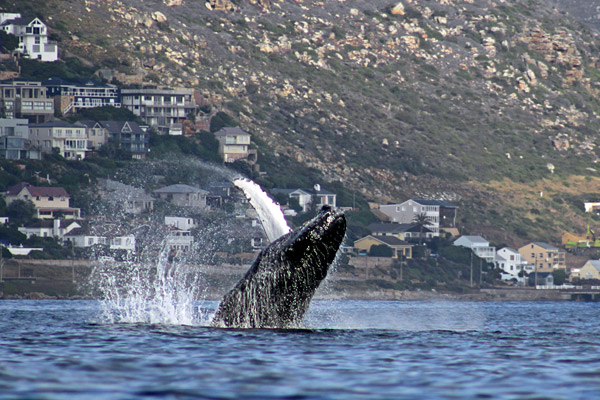
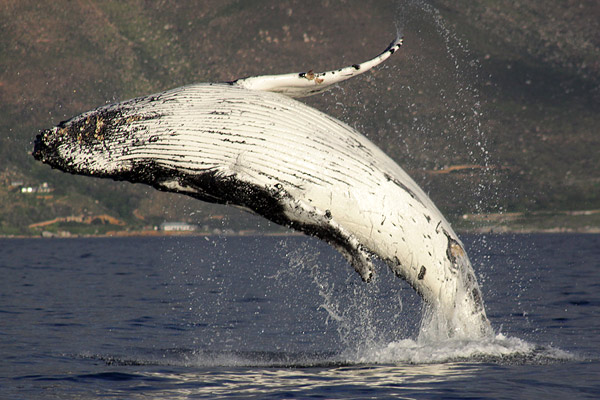
Humpback whales may be found in Cape Town’s waters throughout the year, and their local movements seem to be increasingly tied to feeding opportunities. The familiar north-south breeding migration still forms the main seasonal pattern, but humpback whales around the Cape appear to move between False Bay and the Atlantic coast in response to where food is most concentrated.
Winter and Summer Feeding Whales
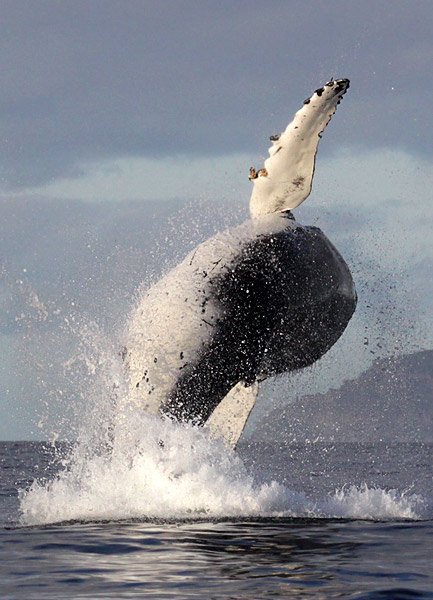
Humpback Whale Feeding Behavior
The phenomenon of feeding humpback whales can result in supergroup gatherings along the west coast between Cape Point and St Helena Bay which may occur anytime from November to February.
The winter of 2024 saw an influx of humpback whales into False Bay, feeding in the shallows and along the kelp fringes near Simonstown. This behaviour was first noticed in 2019 when only a few animals were involved. It will be interesting to see if this develops into a regular seasonal pattern over the comming years.
These feeding aggregations can occur anywhere there are high prey concentrations of krill, mantis shrimp and shoaling fish, as the whales engage in coordinated feeding marked by lunges, bubble blowing, repetitive diving and the distinctly fishy aroma of whale breath hanging in the air!
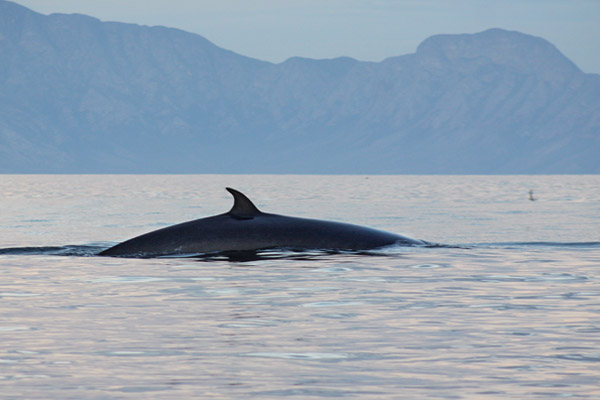
Bryde’s whales have always been closely associated with shoaling fish such as sardine and anchovy, and their movements around the Cape are often a good indication of concentrated bait fish in the area. Known to follow the Sardine Run further east, Bryde’s whales around False Bay and the Peninsula can be encountered year round, with stronger feeding activity in the late summer months.
Feeding Whale Supergroups
Humpback Whale Supergroups
The humpback whale supergroup feeding phenomenon has only recently caught global attention. It seems that the increase in humpback whale populations over the last two decades has seen a return to the feeding grounds of the Benguela upwelling system.
It is now possible to find humpback whales in Summer months almost anywhere along the West Coast, between Cape Point and St Helena Bay.
These groups of feeding whales can quite quickly build from a gathering of only a few animals into super-groups, comprising as many as 200 whales!
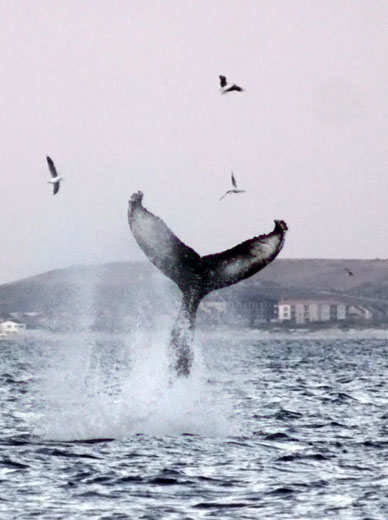
Thought to be among the largest gatherings of Humpback whales in the Southern Hemisphere, the sight of these massive creatures lunging, diving and tailing in unison, amidst a frenzy of seabirds and seals is one of the most spectacular marine life spectacles there is.
Although difficult to predict there are a few areas that are regarded as hot-spots, notably the Dassen Island to Robben Island area and the stretch of coast from Llanduno to Hout Bay, Kommetjie and Cape Point.
Dolphin Watching in Cape Town
Dolphin Species Found In Cape Town
Cape Town is an exceptional location for dolphins, with more species found here than anywhere else on our coastline.
Common dolphins are the most frequently encountered and may often form supergroups numbering in the thousands around False Bay, Hout Bay and Table Bay.
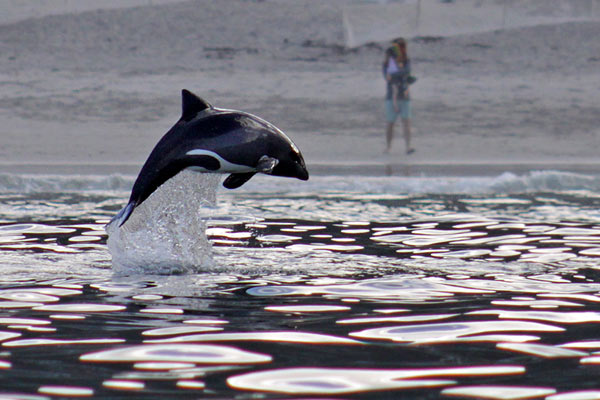
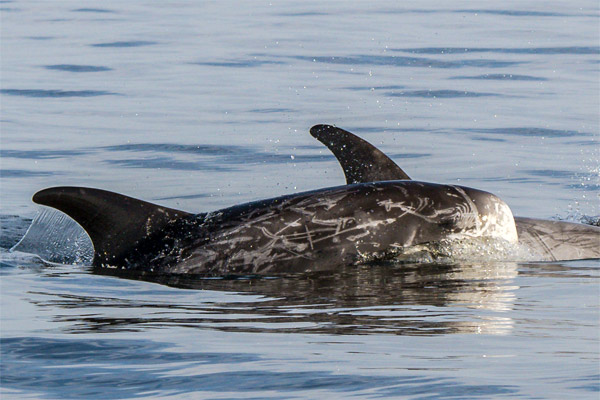
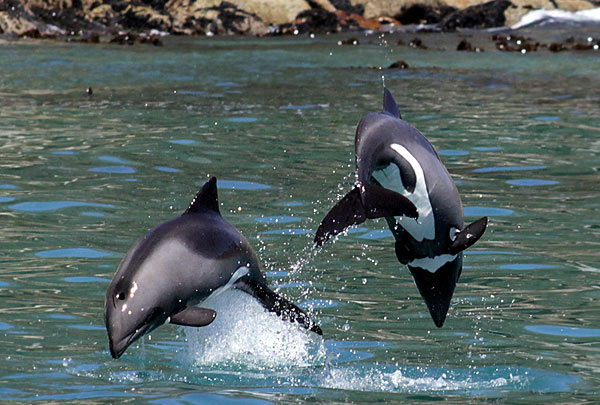
Heaviside’s dolphins are endemic to the southwest coast of Africa. These energetic little dolphins are small, fast and acrobatic, they are always a joy to watch. Dusky dolphins are also regularly encountered and can be highly energetic and inquisitive around boats.
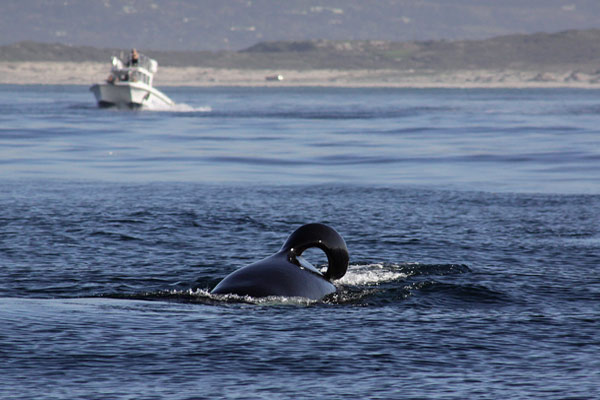
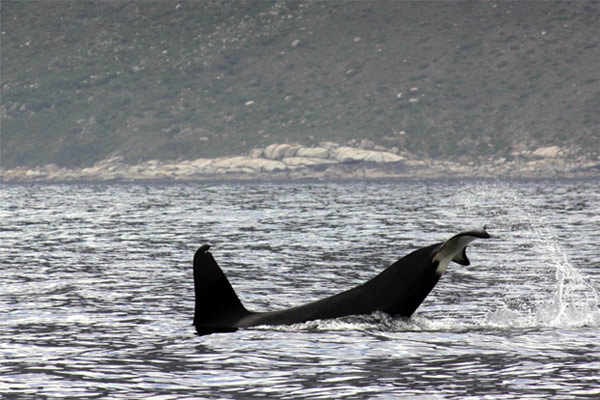
Bottlenose and Indian Ocean humpback dolphins may also be found in False Bay, although this is on the western edge limit of their normal range. Orcas add another exciting layer of unpredictability. They are sometimes encountered offshore around Cape Point and Hout Bay, and are also known to enter False Bay to hunt.
Taken together, this remarkable mix of species makes Cape Town a genuinely special place for cetaceans. The real excitement is that you never quite know what may appear. A quiet morning can change in an instant with the arrival of a large group of dolphins, a feeding frenzy or the unmistakable presence of an Orca.
Planning To Go Whale Watching Cape Town?
Our goal is to help you find the right whale-watching tour.
As a Cape Town based specialist, Oceans Africa has been planning whale watching trips in South Africa for more than 20 years. We are based here, on the water regularly, with a finger on the pulse of current sightings, sea conditions and what is happening in each area.
The questions below cover what travellers most often need to know before booking, and help clarify whether a local trip, Hermanus day tour or more specialist experience makes the most sense for your dates.
The peak month for southern right whales in Hermanus and the De Hoop is usually September with the highest concentations of mother and calf pairs, but the winter season runs from late July through October.
For the feeding groups of humpback whales the season is usually well underway in November and generally continues until the end of Feburary
Whale watching is a game of patience, so allow as much time as possible, even if you find whales, the longer you observe them the more likley you are to experience different behavior. This is especially true with land based whale watching.
A whale watching boat trip can usually get you closer to whales and usually lasts two to three hours, but travellers who are serious about finding whales should allow more than one opportunity where possible.
Every day at sea is different, and whale numbers, locations and behaviour can change from one trip to the next.
Many of South Africa’s best whale-watching areas may also require some travel. Consider a full-day tour or multi-day package to allow more flexibility around weather, cancellations and changing sightings.
Yes. Whale-watching tours in Cape Town generally offer very good value when accessibility, variety and cost are considered together.
Boat trips are competitively priced compared with many other whale-watching destinations around the world.
For many visitors a whale-watching tour is one of the highlights of a trip to Cape Town, but realistic expectations are important. Whales are wild animals, and sightings, numbers and behaviour are never guaranteed. The opportunity to combine boat-based and land-based viewing, other marine-life and activities adds further value to the experience as a whole.
Yes. Serious incidents involving whales and whale-watching boats are extremely rare. Whales are very aware of vessels around them and will usually control their own movements, even when they are approached closely. However, they are large, powerful wild animals, so close encounters need to be managed carefully.
Licensed operators must follow permit conditions governing how vessels approach and interact with whales. Responsible skippers are sensitive to the animals’ behaviour, avoid chasing or crowding them, and allow the whales to determine whether a closer encounter develops.
The vessels must also comply with strict maritime safety requirements. The skipper has the final decision on whether conditions are suitable to go to sea. Guests are given full safety briefings and are asked to disclose any mobility concerns or medical conditions before departure.
Hermanus is the whale capital of South Africa for good reason. During the main southern right season Hermanus is the best option if seeing southern right whales is the priority.
At other times False Bay, Cape Point or the Atlantic coast may offer the stronger opportunity.
To avoid dissapointment book at least two weeks in advance for boat based whale watching trips from Hermanus in peak season, as some departures are fully booked long in advance. It is also a good idea to plan alternate dates as it might be possible to reschedule if the weather forecast look unfavorable.
Oceans Africa are here to help secure your booking.
Boat-based whale watching is weather dependent, and trips may occasionally be cancelled at short notice. The operating supplier will normally offer a refund or rescheduling option according to its booking terms.
On a guided Oceans Africa day tour, the day may still continue with land-based whale watching, coastal sightseeing and other suitable activities where conditions allow.
Conditions at sea are usually colder and windier than they are on land, even on a hot sunnny day you can get cold out on the water. Wear warm layers, a wind-resistant jacket and closed, non-slip shoes.
It is also useful to bring sun protection, sunglasses, a hat. Keep personal items in a small secure bag and bring suitable protection for camera equipment where necessary.
Binoculars are essential for land-based viewing but are not much use on the boat due to motion.
Related Pages on Whales & Dolphins
More Information On Whales And Dolphins In Cape Town
Discover more information about whales and dolphins in Cape Town as well tours and and whale watching charters.

Whales and Dolphins of South Africa
Whale and dolphin species in South Africa Whales & Dolphins of South Africa “… and they rock, through the sensual ageless ages, on the depths of the seven seas and through the salt they reel with drunk delight, and in the tropics tremble they with love and roll with massive, strong desire, like gods.” ―

Whale Watching Tours South Africa
Whale-Watching Tours and Packages WhatsApp Now! For Advice, Availability and Rates “Our tour to Hermanus was unforgettable. We got to see whales from the cliffs as well as several whales up close from the boat, and the coastal drive was simply stunning!!! Oceans Africa organized everything perfectly” Jesse Salmon ★★★★★ Rated 5 out of 5

Feeding Humpback Whale Supergroups
Feeding Humpback Whale Supergroups Want to see Humpback Whales near Cape Town? Humpback whales (megaptera novaeangliae) have always passed the Cape on their long migrations, but in recent years we have seen increacingly large groups of whales gathering to feed both during Winter and Summer. These events are driven by seasonal upwellings in Summer, and

Boat Based Whale Watching
Boat Based Whale Watching WhatsApp Now! For Advice, Availability and Rates “Once in a lifetime experience. We had a rare encounter with multiple humpback whales feeding, penguins diving for food, common dolphins following us, and a beautiful rainbow to top it all off. Anthony Saverina ★★★★★ Rated 5 out of 5 Close-Encounter Whale-Watching in South
